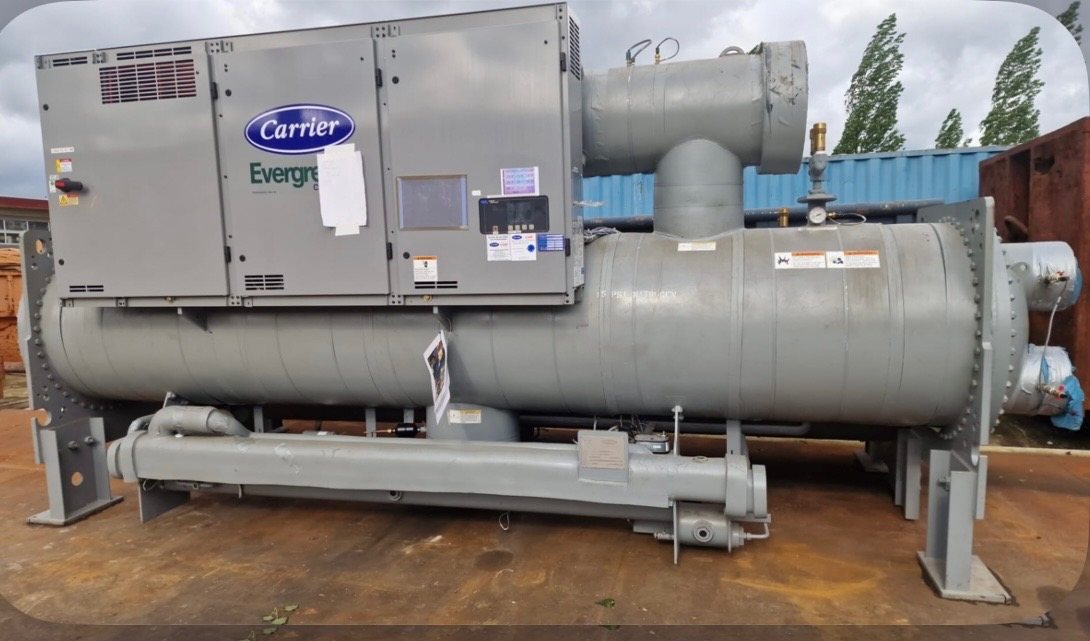
Used Chiller Buyers in Bossier Parish, Louisiana
A practical way to start
If you have a surplus industrial chiller in Bossier Parish, Louisiana, we buy chillers rather than sell them. Share what you know for an upfront cash offer; no equipment testing is required. The buyer handles crane service, rigging, disconnects, refrigerant recovery, loading, hauling and freight, coordinating qualified personnel with the site. A precise inventory and an honest account of access restrictions help shape the removal plan.
Start with the nameplate
Before compiling an equipment list, check whether the record identifies an individual chiller or the whole plant. Send the buyer the safest available photograph of the actual unit and its label, together with any matching schedule. A plate that is obscured or missing can be described honestly; do not remove a cover or enter a restricted area to obtain it.
One machine or several?
A list of assets is especially useful when one room contains multiple similar chillers. Pair each plate photo with a location and say which machine, modules and separate cabinets are included. Identify anything shared or excluded. A plant-wide schedule can accompany the list, but a combined cooling total should not be presented as the rating of each individual unit.
Locating the equipment
Bossier Parish is in northwest Louisiana across the Red River from Shreveport. If a river crossing affects the actual route, tell the freight team; a parish-wide description does not prove that any particular bridge is involved. Provide the street address, the unit's position on the property, and known gate, loading or security limits. These details help the buyer's freight and rigging teams assess the real path to the machine rather than plan from a parish name alone.
What is actually included?
A nameplate tells only part of the story if controls, a starter or modules sit elsewhere. Identify the chiller in a wide photograph and indicate the components that belong to the proposed transaction. Note shared equipment or uncertainties. If the heat-rejection method or compressor type is unclear, available drawings and exterior photos are more useful than a confident guess.
Report condition without a test
Idle equipment does not need to be restarted to demonstrate it. Share a dated service record if available, note missing parts and describe only damage visible from a safe position. If the unit was removed from service for a known reason, explain that without claiming an internal diagnosis. The buyer can assess the submission without a test run.
Measure the load, not just the rating
The buyer needs two different kinds of size information. Rated cooling tons describe performance, whereas transport planning depends on the actual length, width, height and documented weight of each piece. Explain whether a figure covers the whole chiller or a single module and whether a starter or other enclosure is separate. Do not estimate a load weight from cooling capacity.
Plan the disconnects safely
Record power details from labels or drawings already available, and say if the voltage or phase cannot be confirmed. A separate drive or starter may have its own enclosure and removal path, and it may not be part of the purchase. The buyer handles disconnects using qualified personnel, working with authorized staff who control the site's isolation procedures.
Piping and shared loops
Retiring one machine does not necessarily retire the entire loop. Ask the facility's authorized representative to identify shared piping and any systems that must continue operating, using existing drawings where possible. Describe known water or process-fluid interfaces to the buyer. Qualified personnel coordinate isolation and disconnects; the seller should not cut, drain or open connections to obtain an offer.
Refrigerant records and recovery
A retired chiller can still contain refrigerant, so its status should not be inferred from its operating history. Provide the safely visible designation and any known service or recovery notes, including gaps. The buyer coordinates the recovery work through appropriately qualified personnel; the seller leaves the circuit closed and does not vent or transfer refrigerant.
Agree on the work boundaries
Site conditions should be discussed before crews and equipment are assigned. Note any security, escort, loading-hour or shutdown requirements and identify the person authorized to coordinate them. The buyer handles the removal services, while site personnel define their operating and access constraints. Unknown dates or incomplete drawings can be flagged for follow-up rather than filled in with assumptions.
The route out of the building
A facility address can contain more than one gate, building and equipment room. Specify the right entrance and unit location, along with any escort or vehicle restrictions known to the site. If a roof or indoor route is involved, provide opening dimensions and photographs from safe locations. The removal team will assess turns, floor transitions and overhead clearance as well as the doorway.
Crane and rigging considerations
A lift plan depends on more than the cooling rating. Provide the known equipment dimensions, documented weights, roof or room access and any instructions that came with the unit. Tell the buyer about known overhead or ground restrictions and whether staging space is limited. The buyer arranges crane service and professional rigging; qualified personnel determine the lifting and separation method.
Where can the truck load?
A good freight discussion includes the equipment's documented weight, outside dimensions, gate location and space available to load. Identify narrow internal roads, overhead obstructions or restrictions on large vehicles if known. The buyer handles loading and hauling as part of the freight arrangement, while its team checks the actual route with the site. Cooling tons alone cannot establish transport requirements.